
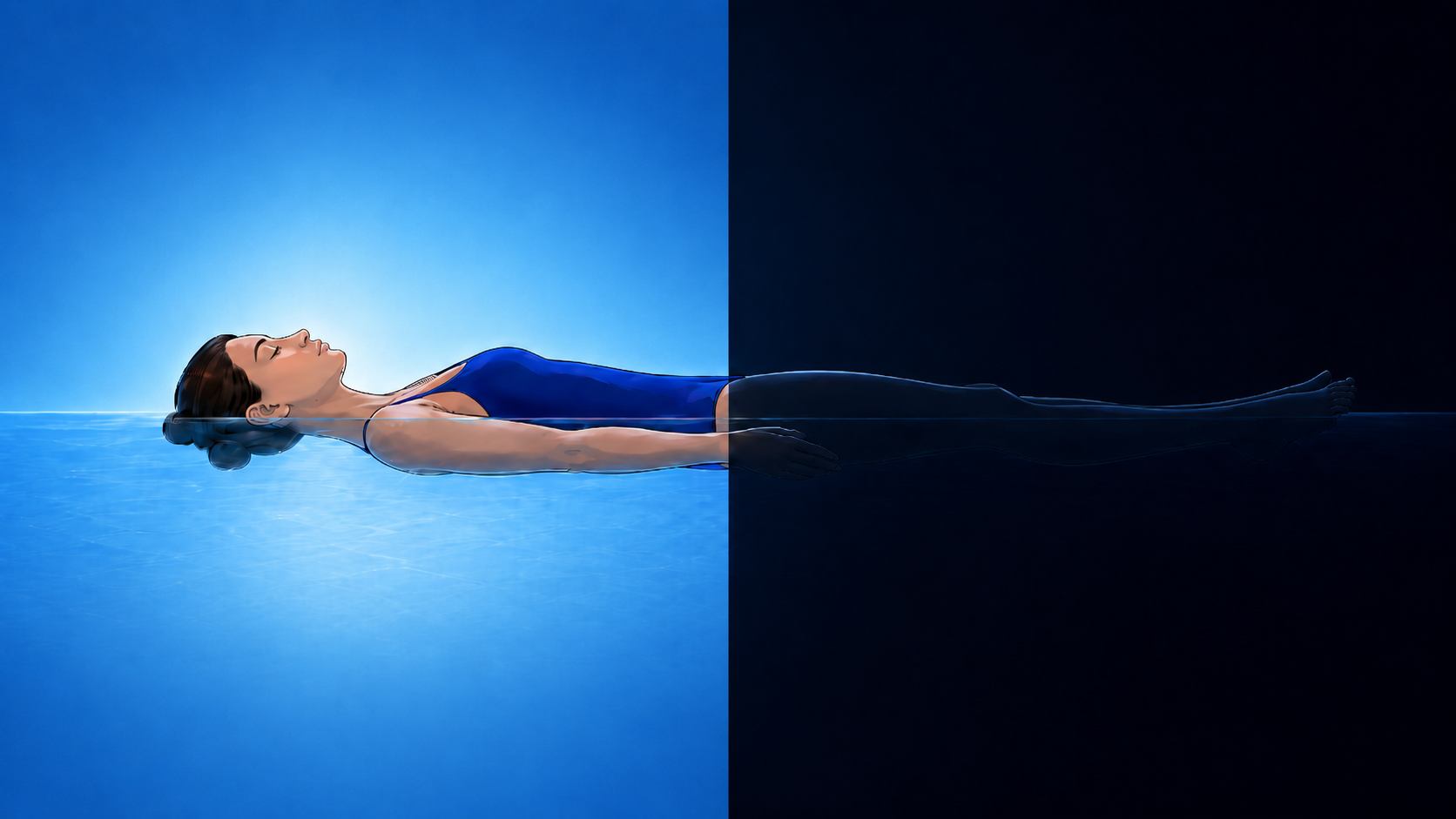
How floatation therapy works
A deeper look at buoyancy, temperature, sensory reduction, and the float experience
Floatation therapy has long been recognised as a powerful way to relax, but understanding exactly how it works has become clearer over time. Early descriptions focused on the experience itself — the feeling of weightlessness, stillness, and mental quiet — supported by early research. Today, those same effects can be understood more clearly through a combination of physical and neurological mechanisms.
Floating was largely understood experientially first, before it was understood scientifically. What is striking is how consistent those early observations were. Modern research into Floatation-REST, built upon earlier research, has helped explain them with greater clarity, while decades of real-world float centre experience have shown how reliably they occur.
Floating does not rely on a single effect. Instead, it brings together several conditions at once, greatly reduced sensory input, effortless buoyancy, physical stillness, and a carefully controlled environment, allowing the body and mind to settle and reset in a way that is difficult with the busyness of everyday life.
This article is part of our Floatation Therapy Guide, exploring how floating works, its benefits, and the different types of float environments.
In this article
- The core mechanisms of floating
- Body temperature and the loss of boundaries
- Epsom salt and effortless buoyancy
- Minimal light, sound, and external input
- Stillness and the removal of effort
- Why the body responds to floating
- Why the combination matters
- What happens during a floatation therapy session?
- Closing summary
The core mechanisms of floating
Floatation therapy is built around a small number of key conditions working together at the same time:
- water heated at, or close to, skin temperature
- high-density Epsom salt water for effortless buoyancy
- absent, or greatly reduced light and sound
- a stable, undisturbed environment
Each of these reduces the amount of sensory stimulation the body and mind must process. Together, they create an environment that lowers external sensory input and physical demands, creating conditions associated with deep relaxation and reduced anxiety. 1, 2, 3.
This is why floating is not just relaxing because it is quiet. It is effective because the environment is designed to minimise sensory demand, remove physical effort, and minimise the need for the body to keep adjusting to what is around it.
The result is a carefully created state in which the body and mind have more opportunity to settle and reset: to move back towards calmness and clarity, a more relaxed body and mind.
This page explains those mechanisms in detail. For the real-world effects people commonly report from floating, see our guide to the benefits of floatation therapy.
Body temperature and the loss of boundaries
The water inside a float tank or room is typically heated to skin temperature, approximately 35.5°C (95.9°F) when the body is relaxed and in a comfortable temperature environment, with the surrounding air carefully regulated to feel similarly neutral.
As the body settles into this environment, temperature receptors in the skin become less active. Many floaters describe a gradual loss of boundary between body and water, as the temperature and environment become so neutral that the distinction begins to fade.
This is one of the defining characteristics of a well-controlled float environment. With far fewer signals for the brain to interpret, the body no longer needs to respond so actively to its surroundings, and a deeper sense of physical and mental stillness can begin to emerge.
Epsom salt and effortless buoyancy
The water is saturated with Epsom salt, or magnesium sulphate. This increases the density of the water enough to support the body completely without effort.
There is no need to balance, adjust posture, or hold yourself up. The body simply floats.
Even when lying on a bed, the body is still making small adjustments to remain comfortable, while muscles continue to respond to gravity, even if far less than when standing. In a float environment, those micro-adjustments are reduced dramatically. With the body fully supported, loading is reduced across muscles and joints, allowing a deeper level of muscular release and physical rest 2, 4.
This support minimises the need for ongoing muscular adjustment. The benefits page explores how this is commonly experienced as relief, lightness, and recovery.
To explore this in more detail, including the role of magnesium, see our guide to Epsom salt and floatation therapy.
To explore the physical effects this can contribute to, see physical relaxation and recovery.
Minimal light, sound, and external input
The float environment is designed to reduce light and sound as much as possible, often completely. This is not about dramatic sensory deprivation, but about reducing the constant stream of external input the brain is used to processing.
In everyday life, the nervous system is continuously responding to visual movement, background noise, changing temperature, the pull of gravity, and subtle shifts in the environment. Even in a relatively quiet room, the brain remains engaged with what is happening around it.
Inside a float environment, this changes. With minimal to no light or sound, there are very few external signals to process. Attention is no longer pulled outward in the same way, and internal sensations can become more noticeable 1, 2.
This reduction in external input is a central part of what is known as Floatation-REST, or Restricted Environmental Stimulation Therapy. In simple terms, the environment reduces outside demand, giving the body and mind less to respond to and more opportunity to return toward balance, regulation, and homeostasis.
Stillness and the removal of effort
Floating is not just about buoyancy. It is about removing the need for effort.
In everyday life, the body is constantly working, maintaining posture, adjusting balance, and responding to gravity. In a float environment, that work is reduced to almost nothing.
With no pressure points, no need to correct position, and far less sensory input to react to, the body can remain completely still. At the same time, the nervous system can begin to shift toward a calmer state, often associated with relaxation, interoceptive awareness, and reduced physiological arousal 1, 2, 3.
This is one of the reasons floating can feel so different from simply lying down to rest. The body is not only resting, it is no longer being asked to keep doing so much in the background.
Why the body responds to floating
To understand why floating works, it helps to understand how the body responds to stress. The body and mind are constantly working to return to a state of balance, rest, and regulation — a process often described as homeostasis.
After exertion, stress, anxiety, or periods of high demand, the body naturally tries to move back toward equilibrium. Sleep, recovery after exercise, wound healing, and deep relaxation are all examples of the body shifting away from strain and toward repair.
As Chris Koster, longtime floater and CEO of Ocean Float Rooms, describes it:
“This state is expressed in many ways. Wounds heal, sleep restores us, the body recovers after exercise, and the same process occurs after acute stress or anxiety. We start moving back towards a more centred state of calmness, reduced anxiety, increased mental clarity, healing, and eased muscle tension.”
The parasympathetic nervous system plays an important role in this relaxation response. Often described as the body’s “rest-and-digest” system, it helps counterbalance the effects of stress by supporting a calmer physiological state 6, 7.
Modern life can make this reset harder to access. Many people spend long periods in a state of alertness, stimulation, and mental demand, which can make stress feel more constant or chronic 8.
This is one reason floatation therapy can feel so powerful. By reducing sensory input, removing physical effort, and creating a stable environment, floating can help reduce sympathetic arousal and support parasympathetic relaxation — giving the body a clearer opportunity to return toward rest, regulation, and centredness 3, 6, 7.
Why the combination matters
It is the combination of these elements, rather than any one factor alone, that creates the distinctive floatation experience.
Skin temperature water reduces sensory contrast. Complete buoyancy removes physical effort throughout the whole body. Absent or reduced light and sound quieten external input.
Together, these conditions create an environment where the body can let go in a way it cannot in everyday life. External processing is reduced, and internal awareness can become more prominent.
Many people report experiencing a state somewhere between wakefulness and sleep — calm, aware, and removed from ordinary external demands 1, 2.
Some floaters also notice a shift in their awareness of time, where without external cues, it can be experienced as either longer, or less defined. For others, deep float states often make time feel shorter, or a floater can experience a sense of timelessness 5.
With fewer external distractions, awareness may also turn inward. Some people become more aware of breathing, heartbeat, or internal sensations, a process often referred to as interoception 2.
Because modern life is so full of movement, screens, sound, and stimulation, this combination creates a rare contrast with the everyday environment most people live in.
In many ways, early and more recent research has helped clarify what floaters and operators had already observed for decades: the float experience depends on several conditions working together, not one factor alone.
Across real float centres, one pattern has appeared again and again: the design of the environment can influence how easily people settle into the float.
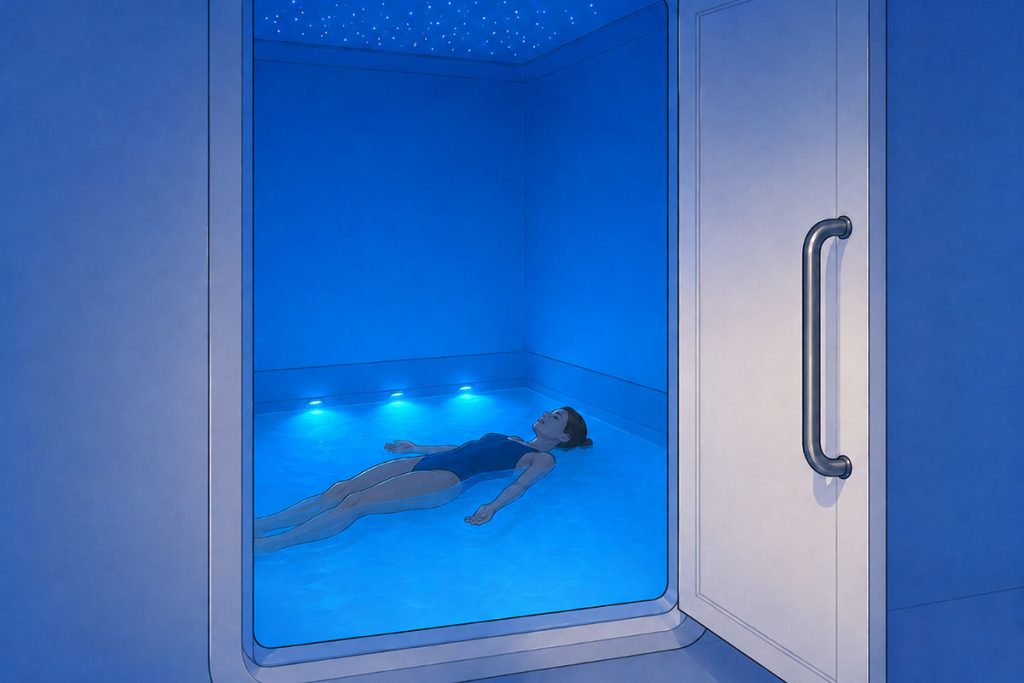
Modern float environments are designed to support this process as clearly as possible. For example, cabins, or full-height, walk-in float rooms are often used in commercial settings to create a more spacious, reassuring environment while maintaining the controlled conditions required for effective floatation therapy.
What happens during a floatation therapy session?
While every float is slightly different, many people notice that the experience unfolds in stages.
1. Settling in
At the beginning of a float session, many people are struck by how effortless it feels to float. At first, there is often still an awareness of the environment — the feeling of the water, or the small adjustments of the body as a comfortable position is found. The mind may also still be carrying some of the momentum of the day.
2. Physical release
As the session continues, the body often begins to let go. Muscles soften, breathing slows, and the effort of holding posture disappears as people begin to trust the buoyancy and surrender more fully to the water.
3. Mental quiet
With minimal sensory input or physical demands, thoughts often become less urgent. Some people experience a meditative state, while others simply notice a growing sense of calm and distance from everyday concerns.
4. Deeper stillness
For some floaters, the later part of the session brings a more profound state of stillness. Awareness can shift, and the sense of time can change. Not every session, especially in the beginning, reaches this stage, and that is perfectly normal.
5. Returning
As the session comes to an end, light or sound is gradually reintroduced. Many people, returning from a state of deep rest, often feel a sense of warmth, heaviness, or calmness throughout the body, which shifts to a sense of clarity, calm, and wellbeing, even lightness as they emerge, shower and dress, and ideally, make for the chill-out lounge to consolidate the benefits.
There is no “perfect” float. Some sessions can be deep, still, and timeless, while others are lighter, more reflective, or simply peaceful. Many people have wonderful first floats, but on average, floats become deeper and more settled with repetition, as the benefits become accumulative, and the body becomes more familiar with the experience.
The body and mind’s reset becomes more complete with repetition. Psychologically, the experience also becomes easier to trust. Together this allows the body and mind to settle more quickly into the conditions of the float.
If you would like to understand how these stages can translate into physical, mental, and emotional outcomes, see our guide to the benefits of floatation therapy.
This is why the design of the float environment matters so much. When the ideal conditions are brought together carefully, the experience can become easier to access and more consistent.
Closing summary
Floatation therapy works by combining body-temperature water, Epsom salt buoyancy, reduced light and sound, and deep physical stillness in one carefully controlled environment.
Together, these conditions reduce sensory demand, remove physical effort, and create a stable context in which the body and mind have less to respond to.
At Ocean Float Rooms, our perspective combines both the insight of early observation and decades of practical experience designing and operating float environments. That combination has shown us repeatedly that floating works best when both the conditions and the environment support the body’s ability to let go.
If you want to continue exploring the topic, read our guide to the benefits of floatation therapy or our introduction to what a float tank is.
Further reading
Related guides
References
- Feinstein JS, Khalsa SS, Yeh H-W, Wohlrab C, Simmons WK, Stein MB, et al. (2018). Examining the short-term anxiolytic and antidepressant effect of Floatation-REST. PLoS ONE, 13(2), e0190292.
- Feinstein JS, Khalsa SS, Yeh H, Al Zoubi O, Arevian AC, Wohlrab C, et al. (2018). The Elicitation of Relaxation and Interoceptive Awareness Using Floatation Therapy in Individuals With High Anxiety Sensitivity. Biological Psychiatry: Cognitive Neuroscience and Neuroimaging, 3(6), 555–562.
- Flux MC, Fine TH, Poplin T, Al Zoubi O, Schoenhals WA, Schettler J, et al. (2022). Exploring the acute cardiovascular effects of Floatation-REST. Frontiers in Neuroscience, 16, 995594.
- Caldwell LK, Kraemer WJ, Post EM, Volek JS, Focht BC, Newton RU, Häkkinen K, Maresh CM. (2022). Acute Floatation-REST Improves Perceived Recovery Following a High-Intensity Resistance Exercise Stress in Trained Men. Medicine & Science in Sports & Exercise, 54(8), 1371–1381.
- Hruby H, Schmidt S, Feinstein JS, Wittmann M. (2024). Induction of altered states of consciousness during Floatation-REST. Scientific Reports, 14, 9316.
- Benson H, Greenwood MM, Klemchuk H. (1975). The relaxation response: Psychophysiologic aspects and clinical applications. International Journal of Psychiatry in Medicine, 6(1–2), 87–98.
- Deckro GR, Ballinger KM, Hoyt M, Wilcher M, Dusek J, Myers P, Greenberg B, Rosenthal DS, Benson H. (2002). The evaluation of a mind/body intervention to reduce psychological distress and perceived stress in college students. Journal of American College Health, 50(6), 281–287.
- Kiecolt-Glaser JK, Glaser R. (2005). Stress-induced immune dysfunction: Implications for health. Nature Reviews Immunology, 5, 243–251.